Why some places become cultural magnets… and others never quite get there
There’s a story cities love to tell themselves.
“If we build a big venue, bring in a festival, and market it hard enough… we’ll become a music city.”
It sounds logical. It feels actionable. It looks impressive on paper.
It’s also wrong.
Because if you study every city that actually became a music capital not just labeled itself one you’ll find a completely different pattern.
They didn’t start at the top.
They started somewhere much smaller.
The Truth Most People Miss
Music cities aren’t built by attracting famous artists.
They’re built when unknown artists have somewhere to belong.
Before the headlines, before the festivals, before the branding…
There’s always a foundation.
And that foundation follows a very specific structure.
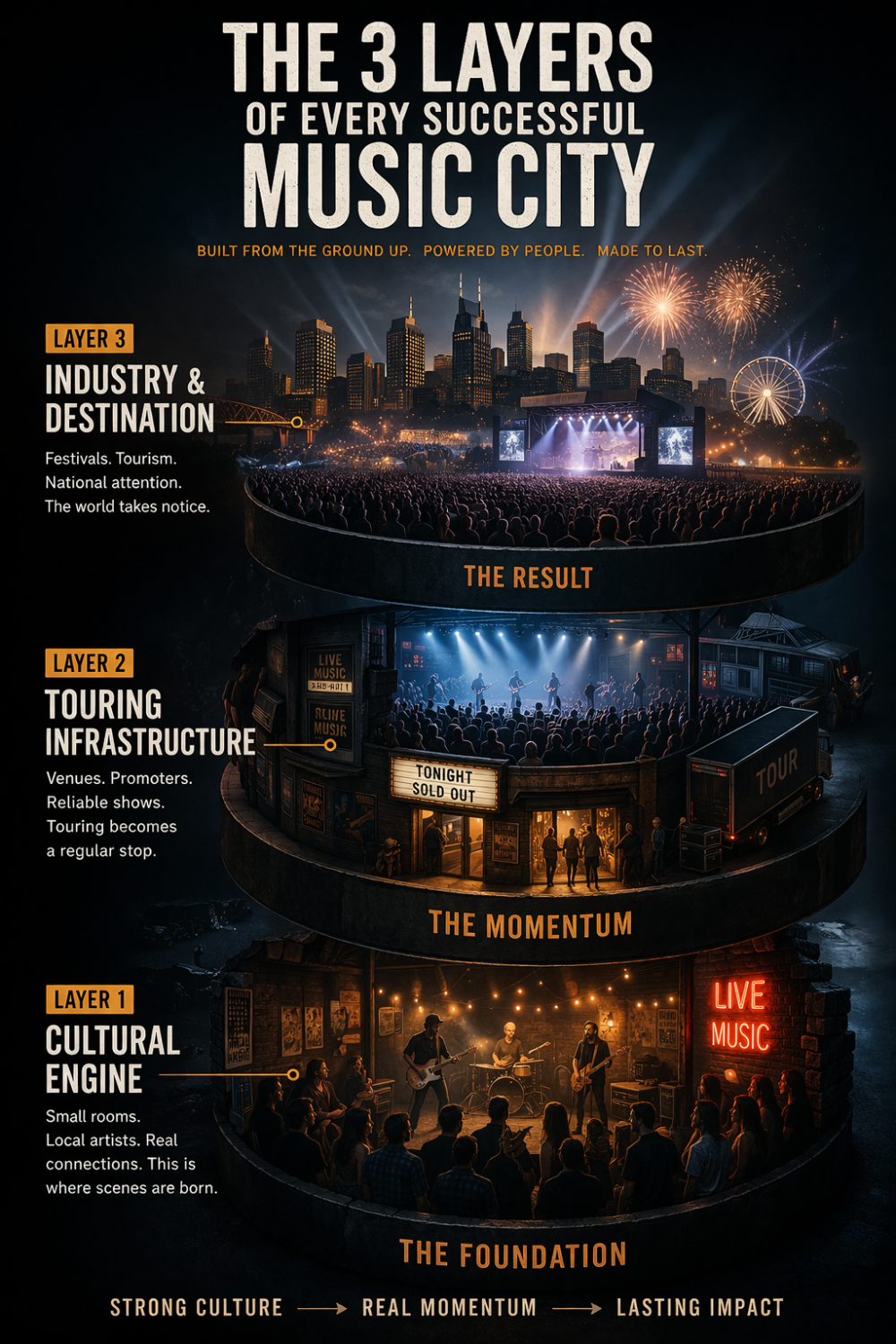
The 3 Layers of a Music City
Every real music ecosystem forms in three layers:
Layer 3 — Industry & Destination
Layer 2 — Touring Infrastructure
Layer 1 — Cultural Engine
Most cities try to build Layer 3 first.
Successful cities build from the bottom up.
Let’s break that down.
Layer 1: The Cultural Engine
Where scenes are born (and where everything actually starts)
This is the layer almost nobody funds… but every music city depends on.
It’s not glamorous.
It doesn’t always make money.
And from the outside, it can look small.
But inside these spaces, something powerful is happening.
This is what Layer 1 looks like:
- A packed room on a random Thursday
- A band trying something new for the first time
- The crowd standing five feet from the stage
- Musicians watching other musicians
- People staying long after the set ends
It’s messy. It’s raw. It’s alive.
And more importantly…
It’s consistent.
What these venues actually create
They’re not just hosting shows.
They’re building:
- Identity → “This is our place.”
- Discovery → “I might see something great tonight.”
- Belonging → “These are my people.”
That combination is rare.
And once it forms, it becomes magnetic.
The rule that changes everything
Artists don’t move to cities. They move toward scenes.
And scenes don’t form where everything is polished.
They form where people are allowed to show up, try, fail, and come back again next week.
Layer 2: Touring Infrastructure
Where culture turns into momentum
Once a city has a real cultural engine, something starts to shift.
Not loudly. Not all at once.
But noticeably.
Audiences start behaving differently.
- They show up consistently
- They trust the venue
- They buy tickets without overthinking it
And suddenly…
A new kind of venue becomes viable.
This is Layer 2:
- 500–1,200 capacity rooms
- Professional sound and lighting
- Ticketed shows with predictable turnout
- Promoters who can confidently book acts
This is where touring begins to take hold.
Not because the city asked for it.
But because it became reliable.
What agents are really looking for
Touring decisions aren’t emotional.
They’re mathematical.
Agents want to know:
“If we stop here… will it work?”
Layer 1 gives them the answer.
Because it proves:
- people show up
- the crowd cares
- the experience is consistent
Without that proof, they skip the city.
Every time.
Layer 3: Industry & Destination
Where the world finally pays attention
This is the part everyone sees.
- Festivals
- Tourism
- Media coverage
- Branding campaigns
- “Music Capital” titles
It looks like the beginning.
But it’s actually the end result.
Here’s the uncomfortable truth
No city becomes a music destination because it said it was one.
It becomes a destination because:
- artists talk about it
- crews enjoy stopping there
- audiences make it worth returning
The reputation spreads organically.
Then the branding follows.
The Flywheel That Changes Everything
When all three layers align, something powerful happens:
- Artists gather
- Small venues build trust
- Audiences form habits
- Bigger shows start working
- Touring routes expand
- The scene grows
- More artists move in
And the cycle repeats.
Not once.
But continuously.
So Where Does Corpus Christi Fit?
If we’re being honest, and this conversation deserves honesty, Corpus isn’t starting from zero.
But it’s also not fully connected yet.
Layer 1: Cultural Engine
It exists.
There’s talent. There’s creativity. There are moments.
But it’s not yet concentrated enough to feel undeniable.
Layer 2: Touring Infrastructure
This is the gap.
There isn’t a consistent, trusted anchor venue where agents feel confident booking regularly.
So routing remains uncertain.
Layer 3: Industry & Destination
It shows up occasionally.
But not as part of a system.
More like isolated events.
Why This Is Actually Good News
Because most cities try to solve the hardest problem first.
Corpus doesn’t need to.
The opportunity isn’t to compete with Austin.
It’s to do something much more realistic and much more powerful:
Build Layer 1 so strong that everything else becomes inevitable.
What That Really Means
Not more marketing.
Not bigger announcements.
Not chasing outside validation.
It means:
- creating consistency
- building a true home for live music
- giving artists a place to return to
- giving audiences a reason to trust showing up
Over and over again.
The Moment That Changes Everything
Every music city has a turning point.
It doesn’t happen when a big artist comes through.
It doesn’t happen when a festival launches.
It happens when something much quieter shifts:
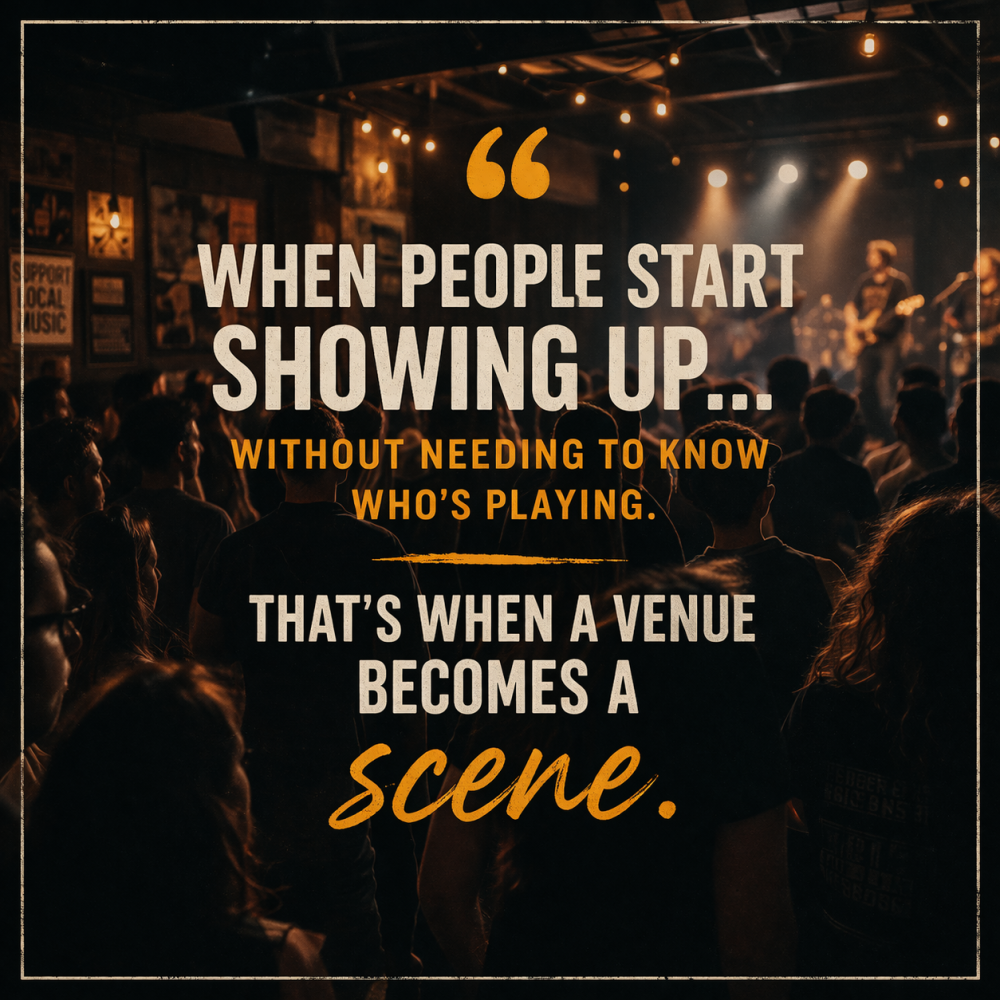
People start showing up… without needing to know who’s playing.
That’s when a venue becomes a scene.
And that’s when a city starts becoming something more.
The Question That Matters Now
Corpus doesn’t need to ask:
“How do we become a music city?”
The better question is:
“How do we make our scene impossible to ignore?”
Because once that answer is real…
Everything else starts to follow.